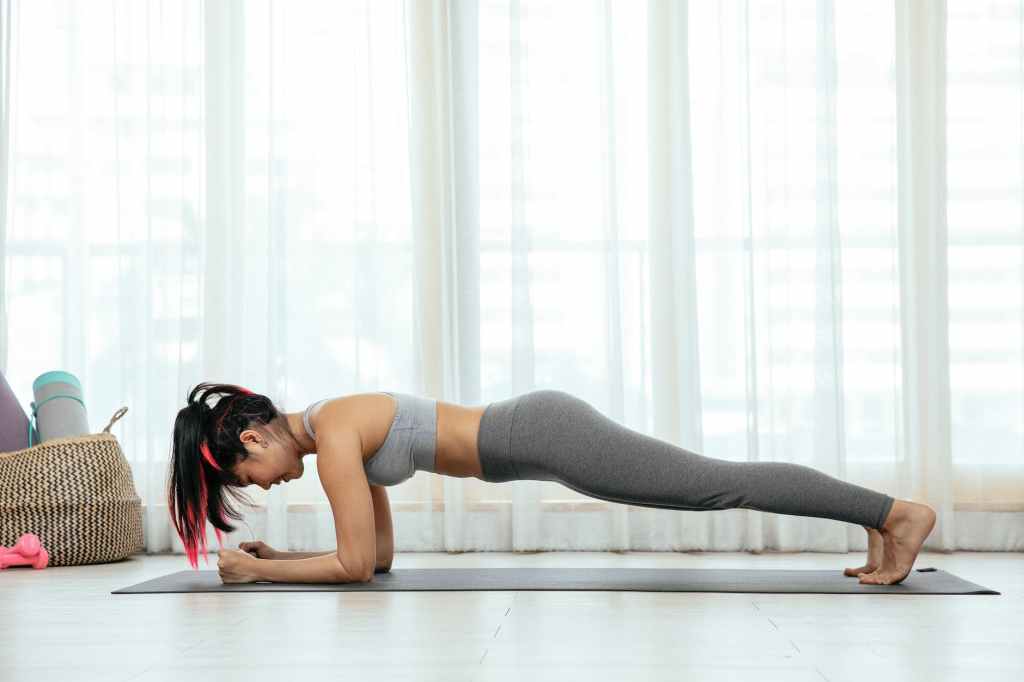
On the surface, the plank looks quite simple to do. It involves no movement and does not require any equipment. But despite this apparent simplicity, the plank is commonly done poorly by both beginners and more experienced gym goers.
While most issues can be fixed with better instruction, this is only a temporary solution. When that person takes time off from the gym or moves on to different plank variations, they regress back.
To prevent this, there needs an understanding of why the plank is done. That understanding starts with examining the role that core muscles have in human movement.
JOB OF THE CORE
If you were to ask the average person why they do core exercises in the gym, you would almost always get an answer tied to aesthetics. People will say they want to look good by the pool this summer.
Unfortunately, this is another misunderstanding. The way to get strong abdominal definition is by having a low percentage of body fat. Six-pack abs are not so much achieved in the gym as they are in the kitchen.
This misconception is an old one and it stems from not understanding the job of the core muscles. People believe the abdominals are big power-generating muscles like our glutes. They then try to work the muscles in active power generating ways like sit-ups or twist machines.
But the core muscles actually serve a very different purpose. The primary job of the core is not to generate movement, but to stabilize the trunk and transfer power. The core muscles are more about resisting movement than they are about producing it on their own.
This is more easily understood by looking into the real world for examples. Think of the core muscles during a squat. They do not bend or move much. They stabilize the spine and keep the torso upright against the load of the weight. Think of a running back trying to break a tackle. Their torso stays braced so it can transfer lower body power up into the point of contact.
Once you understand this concept then you can start to apply it to your workouts. You will realize that the most effective core exercises are anti-movement rather than movements. You want your core muscles to resist force and stabilize. You want to force the core to brace and remain unmoving while under tension.
You might have noticed by now that this sounds very similar to your body during a plank. During a plank the body is forced to brace the core muscles against the force of gravity pulling down. Rather than actively generating movement, the body is resisting movement.
HOW TO DO A PLANK
Now we arrive at how to properly do a plank. The exercise has many variations, but in this article, we will stick to the most common version: the elbow plank, also known as the front plank.
- Lie down facing the ground. Come up onto your elbows, making sure your elbows are lined up beneath your shoulders. You want your forearms going straight forward and your palms flat on the ground.
- Now come up onto your toes and gently raise your hips up off the floor until your body is in a straight line from your ears to your toes.
- Create tension by engaging your glutes and abdominals. Imagine someone is going to hit your stomach. Take a deep breath and tighten up your abdominals. Now do the same with your glutes.
- Hold until the time is up. Make sure you maintain steady, controlled breathing and hold tension the entire time.
Some points of emphasis while holding the plank position:
- Keep your head in a neutral position. Think of someone standing at attention. Do not look up or to the sides. This is to ensure our spine stays in a strong position the entire time. If you want to check your form, do not look in a mirror but use your phone to take a video instead.
- Do not forget to take deep, steady breaths. If you have a problem with breathing then I would encourage you to start counting your breaths during the plank, this will help
- If you feel your lower back start to ache then tuck your tailbone. Think of how a dog tucks their tail, this is what you want to try and do.
Final Thoughts
Those instructions seem rather obvious and simple to execute. In many ways this is true, but as time goes on people tend to go autopilot on planks. People hold planks for longer, but with less benefit. This is because they are not bracing as hard as they were during the shorter holds. The tension must be created every single time you get down into a plank or you will not receive the full benefit.
The plank is one of the most effective core exercises you can do in the gym, it should be a staple of your workout routine. If you remember the principles behind the exercise, it will serve you well for years to come
 Pimenta Performance
Leave a comment